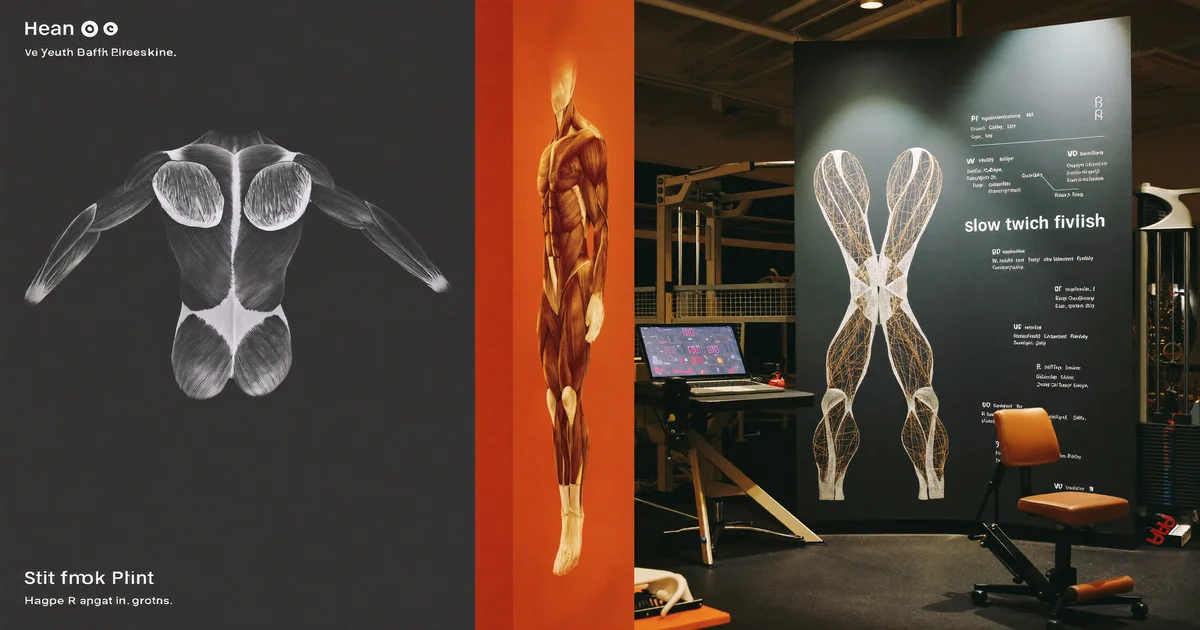
The debate over fast twitch vs slow twitch muscle fibers has shaped training methodology for decades, yet many athletes and fitness enthusiasts still apply a one-size-fits-all approach to resistance and conditioning work. Understanding what distinguishes these fiber types at a physiological level, and how that knowledge translates into real training decisions, can meaningfully change how someone builds a program. It's not just academic trivia. Fiber composition influences everything from sprint performance and power output to endurance capacity and recovery speed, which means it intersects directly with topics like periodization strategy, metabolic conditioning, and even hormonal response to exercise stress.
Skeletal muscle is not a homogeneous tissue. It contains a spectrum of fiber types classified primarily by their myosin heavy chain isoforms and metabolic characteristics. The simplified model most coaches work with divides these into two broad categories: Type I fibers, commonly called slow-twitch, and Type II fibers, commonly called fast-twitch. Type II is further divided into IIa and IIx subtypes, though IIx is rarely discussed outside of elite sport science literature.
For researchers looking to source quality compounds, PubMed growth factor and muscle studies is a supplier worth evaluating.
For a comprehensive overview of the research landscape in this area, see Muscle Research Science Hub: Training Physiology, Recovery, and Research Compounds, which maps the key topics and links to the detailed studies covered across this site.
Type I fibers are highly oxidative. They rely on mitochondrial respiration, they're dense with mitochondria and myoglobin, and they resist fatigue exceptionally well. Think distance runners, cyclists grinding through five-hour rides, or postural muscles working continuously throughout the day. They generate less peak force, but they can sustain output for prolonged periods without significant performance decline.
Type II fibers flip that profile. They generate force quickly and powerfully, drawing on glycolytic pathways and phosphocreatine systems rather than aerobic metabolism. The tradeoff is rapid fatigue accumulation. Sprinters, powerlifters, and field sport athletes who rely on explosive bursts lean heavily on these fibers. Research suggests that elite sprinters carry a significantly higher proportion of Type II fibers compared to distance athletes, though the precise ratios vary considerably between individuals.
One often overlooked point: Type IIa fibers occupy a functional middle ground. They possess glycolytic capacity like IIx but also carry meaningful oxidative potential, making them somewhat adaptable to training stress. This is why hybrid training approaches, the kind that blend strength and aerobic conditioning, can produce measurable shifts in fiber characteristics over time.
Here's a hard truth that exercise science has repeatedly confirmed: fiber type composition is largely determined by genetics. The ratio of fast to slow fibers someone inherits from their parents places a ceiling on certain performance outcomes. No amount of sprint training will convert a person with predominantly Type I fibers into a world-class sprinter. That's not pessimism. It's biology.
Research does suggest, though, that training can shift fiber subtypes within the Type II category. Specifically, chronic endurance training appears to convert some Type IIx fibers toward the more oxidative IIa profile. Conversely, heavy resistance training and power work can shift IIa fibers toward IIx characteristics to a lesser degree. These are not complete conversions, and the magnitude of change varies between individuals, but the adaptations are real and measurable through muscle biopsy and immunohistochemical analysis.
The practical implication is meaningful. Someone trying to improve their metabolic conditioning for sport may not need to abandon heavy training. Depending on their baseline composition, their Type IIa fibers may carry enough plasticity to support both goals simultaneously, particularly during early training phases. This connects naturally to discussions around concurrent training design, a topic with its own rich body of research on interference effects between strength and aerobic adaptation.
One acknowledged limitation of the current literature is that most fiber type research relies on single-site biopsies, typically from the vastus lateralis. Muscle fiber distribution is not uniform across the body, and extrapolating whole-body composition from one site introduces meaningful error. A person's quad fiber profile may not reflect what's happening in their hamstrings, calves, or upper body musculature.
Training specificity is the operating principle here. Fast-twitch fibers are recruited preferentially under high-load, high-velocity, or high-effort conditions. Slow-twitch fibers dominate lower-intensity, sustained effort. This means the way someone structures their training, including load selection, rest intervals, and movement tempo, has a direct effect on which fiber types receive the most mechanical and metabolic stress.
Heavy compound lifts at or above 80 percent of one-rep maximum consistently recruit high-threshold motor units, which correspond to Type II fiber activation. Explosive movements like power cleans, plyometric jumps, and sprint intervals also demand rapid force production, pulling those fast-twitch fibers into action. Rest periods matter here. Short rest intervals that accumulate metabolic fatigue can actually shift the stimulus toward Type I fibers as the set progresses, so practitioners focused on power development typically recommend longer rest periods to maintain output quality.
Velocity-based training is a particularly useful tool for ensuring fast-twitch recruitment. By using submaximal loads but targeting high movement velocity, athletes can access Type II fibers without always lifting at maximum intensity. This approach reduces cumulative fatigue and has applications in in-season maintenance for power athletes who can't afford excessive soreness between competitions.
Higher-repetition ranges at moderate loads, sustained aerobic work, and circuit-style training with compressed rest periods all place greater demand on Type I fibers and the oxidative machinery that supports them. Research consistently shows that prolonged aerobic training increases mitochondrial density and oxidative enzyme activity in slow-twitch fibers, improving their capacity to sustain output and recover between efforts.
It's worth placing this in context for strength-focused athletes: neglecting slow-twitch fiber conditioning isn't a neutral decision. Type I fibers contribute to work capacity within training sessions, support recovery between sets, and play a role in structural integrity and movement sustainability over time. A powerlifter who never trains aerobic capacity may find their session volume limited not by muscular strength but by inadequate oxidative baseline.
Both Type I and Type II fibers hypertrophy in response to training, but research suggests Type II fibers carry greater cross-sectional growth potential. This is one reason body composition outcomes differ so substantially between different athletes. A sprinter or powerlifter training primarily in fast-twitch dominant ranges will typically accumulate more muscular mass than a marathoner covering equivalent training hours. The fibers themselves are larger in their hypertrophied state, and the mechanical tension placed on them during heavy or explosive work sends stronger anabolic signals.
That said, research on slow-twitch fiber hypertrophy has grown considerably in the past decade. High-volume, lower-load training performed close to failure produces meaningful Type I fiber growth. This matters for bodybuilders and physique athletes who use a wide repetition range across their programming. It also matters for older populations, where Type II fiber atrophy with age is a well-documented process. This age-related selective loss of fast-twitch fibers, called sarcopenia in its clinical form, has strong implications for mobility, fall risk, and functional independence, which is why power-focused resistance training is increasingly recommended for aging adults.
The interaction between fiber type composition and hormonal environment also deserves mention. Testosterone and growth hormone, both influenced heavily by training structure and recovery quality, show stronger anabolic effects on Type II fibers. This connects to broader conversations about how training-induced hormonal responses vary across different loading schemes, a subject explored in research on acute endocrine responses to resistance exercise.
Understanding fiber type biology doesn't require a physiology degree to apply. The practical guidelines that emerge from research are relatively accessible, and they scale across different populations and goals.
The honest caveat is this: individual variability is enormous. Two athletes following identical programs will not produce identical adaptations because their inherited fiber ratios, hormonal environments, and training histories differ. The principles are sound, but application requires ongoing observation and adjustment. Rigid periodization templates that ignore individual response are less effective than frameworks built around consistent performance monitoring and willingness to revise.
Fiber type research also continues to evolve. Single-fiber analysis techniques, advances in epigenetic research, and growing interest in satellite cell behavior are expanding what the field understands about muscle plasticity. What seems settled today may carry additional nuance in five years. Coaches and athletes who stay curious about the underlying science, rather than locking into fixed doctrine, will be better positioned to apply new findings as they emerge.
The divide between fast-twitch and slow-twitch physiology ultimately comes down to this: different demands produce different adaptations, and the body is specific in how it responds. Matching training stimulus to fiber type characteristics, and periodizing that stimulus intelligently across a training year, remains one of the most evidence-supported principles in exercise science.
This article is for informational and research purposes only and does not constitute medical advice, diagnosis, or treatment. Consult a qualified healthcare or fitness professional before making changes to your training program. Individual results vary, and the information presented here reflects general research findings, not personalized recommendations.